









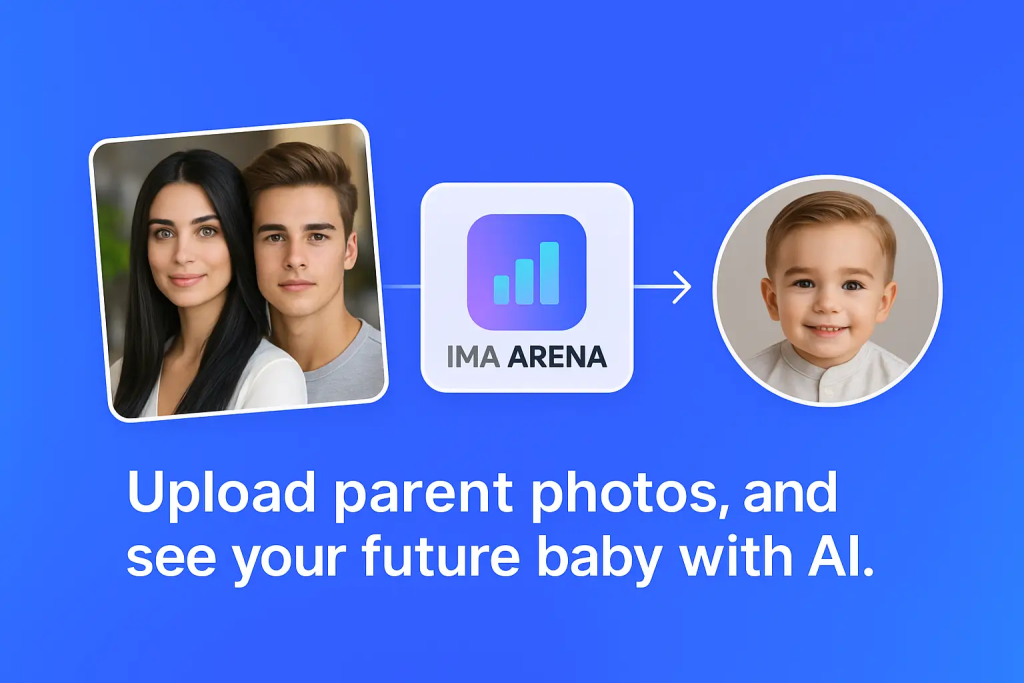
Curious about “what will my baby look like”? This guide blends the science of genetics with practical, safe ways to try an AI baby generator. You’ll learn what traits are (and aren’t) predictable, how to use an AI baby face predictor responsibly, and how Ima Studio helps you get the most realistic results—without misleading claims.
Key takeaways
- Most appearance traits—eye color, hair color, skin tone, face shape, height—are polygenic and influenced by environment, so no tool can guarantee your baby’s exact look.
- AI baby generators are fun visualizations, not medical predictions. Use them for entertainment and inspiration, not health decisions.
- Ima Studio’s AI Baby Generator tests multiple top models in parallel and selects the best result automatically, helping you get a more realistic image with less trial-and-error.
How genetics shapes what your baby may look like
In search results for “what will my baby look like,” you’ll find simple “baby morph” tools and community discussions. Here’s the scientific context to set the right expectations.
Eye color
- Old “brown dominates blue” charts are oversimplified. Eye color depends on many genes (including OCA2 and HERC2) and the amount of melanin in the iris.
- Newborns’ eyes can appear gray/blue and darken as melanin accumulates over the first months; some changes may occur into toddler years.
- Authoritative reference: MedlinePlus Genetics on eye color inheritance.
Learn more: MedlinePlus Genetics: What determines eye color?
Hair color and texture
- Hair color involves many genes; variants in MC1R are well-known for red hair, but overall prediction is still probabilistic.
- Texture and curl pattern are also polygenic and can vary widely even among siblings.
Learn more: MedlinePlus Genetics: MC1R gene
Skin tone
- Skin tone is determined by multiple genes that influence melanin production and distribution, and can be affected by environment (e.g., sun exposure).
- Simplistic “blend” expectations may not match real outcomes because of complex inheritance.
Background reading: NHGRI: Complex traits
Face shape and features
- Nose shape, lips, jawline, dimples, freckles are controlled by many genes; there is no precise consumer test to predict how these combine.
- Babies also change rapidly postnatally; soft-tissue growth alters apparent resemblance over time.
Height and body build
- Height is highly polygenic and influenced by nutrition and health. Parental height gives a broad range, not a fixed outcome.
Basics: CDC: Genomics and health basics
Why your baby might not look like you: Even with shared DNA, the combination of variants can yield unexpected appearances. See: Yale Baby School: Why doesn’t my baby look like me?
Can AI really predict what my baby will look like?
AI baby generators use face analysis and generative models to create a plausible infant image based on two adult photos. This is a visual simulation—not a genetic prediction. Quality depends on the input photos, the model, and how responsibly the tool blends traits.
Where AI helps: exploring multiple “what will my baby look like” possibilities fast, with different ages and styles (newborn, 6 months, toddler; realistic vs. stylized). Where AI falls short: it cannot forecast real-world traits or health outcomes, and it may overemphasize certain parent features.
Try a safe, realistic AI Baby Generator in Ima Studio
Ima Studio is an AI creation agent that integrates leading image and video models. For baby face prediction, Ima Studio runs a model “arena”: multiple models generate results from the same prompt and photos, and the system (or you) picks the best output. That reduces the guesswork—and often yields a more lifelike image.
How to use Ima Studio’s AI Baby Generator
- Open: AI Baby Generator.
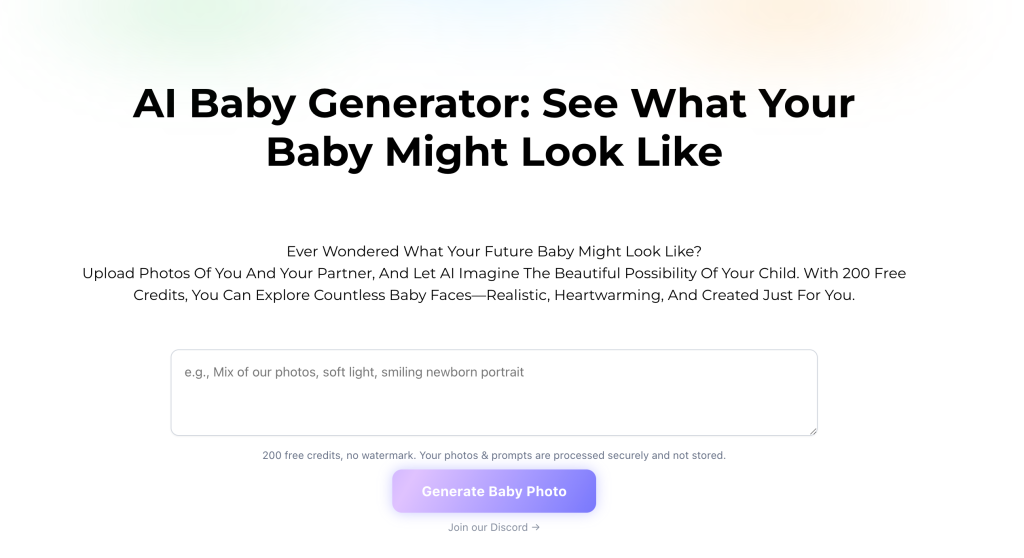
- Upload two clear, front-facing parent photos (no heavy filters; good lighting).
- Choose preferences (e.g., age range, realism vs. stylized).
- Generate. Ima Arena will test top models on the same inputs and surface the best-looking result. You can view alternatives and vote for your favorite.
- Refine with a quick prompt (e.g., “6-month-old, soft daylight, natural skin tone”).
- Download. For fine edits, try Chat with Photo.
Want inspiration? Browse ready-made templates in the Ima Studio Community and apply them with one click.
Privacy and consent: Upload photos you have the rights to and avoid images of minors. Review our Privacy Policy and Terms before use. AI outputs are for entertainment and should not guide medical or genetic decisions. For genetic screening questions, see ACOG: Carrier screening.
Get better results: 7 tips for more realistic baby images
- Use front-facing, high-resolution photos for both parents; avoid sunglasses, hats, or extreme makeup.
- Neutral lighting and plain backgrounds help the model read facial structure accurately.
- Include both parents’ photos; single-parent inputs reduce trait diversity.
- Set a realistic age (newborn to 12 months) for more believable proportions.
- Keep prompts simple: describe age, lighting, and realism; avoid long style lists.
- Compare multiple outputs in Ima Arena; pick the one with natural skin texture and balanced resemblance.
- Remember: genetics is complex—treat results as imaginative previews, not predictions.
Best “what will my baby look like” tools: quick comparison
| Tool | Inputs | Output styles | Notable features | Learn more |
|---|---|---|---|---|
| Ima Studio AI Baby Generator | Two parent photos, optional prompt | Photorealistic and stylized; multiple age options | Model Arena runs several SOTA models in parallel; community templates; refinement via Chat with Photo | Try now |
| Fotor Baby Generator | Two photos | Photorealistic morphs | Simple web workflow | Fotor |
| MakeMeBabies | Two photos | Classic morphs | Long-running “baby morph” tool | makemebabies.com |
| AIease AI Baby Generator | Two photos | Photorealistic outputs | Quick online interface | AIease |
Note: Features summarized from public pages at the time of writing; check each site for current details and policies.
FAQ: “What will my baby look like?”
Can DNA tests tell me exactly what my baby will look like?
No. While genetic screening can inform carrier status for certain conditions, physical appearance is influenced by many genes and environment. Consumer services cannot guarantee specific appearance traits. For medical decisions, consult your clinician and see ACOG’s guidance.
When do babies’ eye colors stabilize?
Eye color often shifts over the first 6–12 months as melanin develops, with some changes into toddler years. See MedlinePlus Genetics.
Why doesn’t my baby look like either parent?
Appearance is a complex mix of genetic variants from both parents (and earlier generations). Random assortment can yield unexpected combinations. See the Yale Baby School overview.
Are AI baby predictors safe to use?
Use reputable tools, upload only photos you have the right to use, and review privacy/terms. Avoid relying on AI outputs for medical or genetic decisions. See Ima Studio’s Privacy Policy and Terms.
Related resources
- Try: Ima Studio AI Baby Generator
- Compare AI models live: Ima Arena
- Templates to start fast: Ima Studio Community
- Other tools users explore: Fotor, MakeMeBabies, AIease
Bottom line: If you’re asking “what will my baby look like,” genetics can offer probabilities, not guarantees. Use a responsible AI baby generator like Ima Studio to explore fun, realistic possibilities—while keeping expectations grounded in science.
About The Author