








Looking for an AI film competition to enter?
Here’s the honest lay of the land right now:
The Google Global AI Film Award — the one that gave out $1 million and made Lily famous — closed in November 2025. 3,500 entries, one winner. That window is gone.
AI for Good Film Festival — 13 days from now. The theme is tightly scoped around AI for social good, which means if your story doesn’t fit that lens, it’s not the right entry point.
Curious Refuge has $10,000 on the table and closes March 10 — eight days from now. Tight, and the prize pool is modest for the effort involved.
Runway’s AI Festival runs through March 31 — well-established, now in its fourth year, but competitive enough that the submission pool reflects that.
Then there’s GAIC.
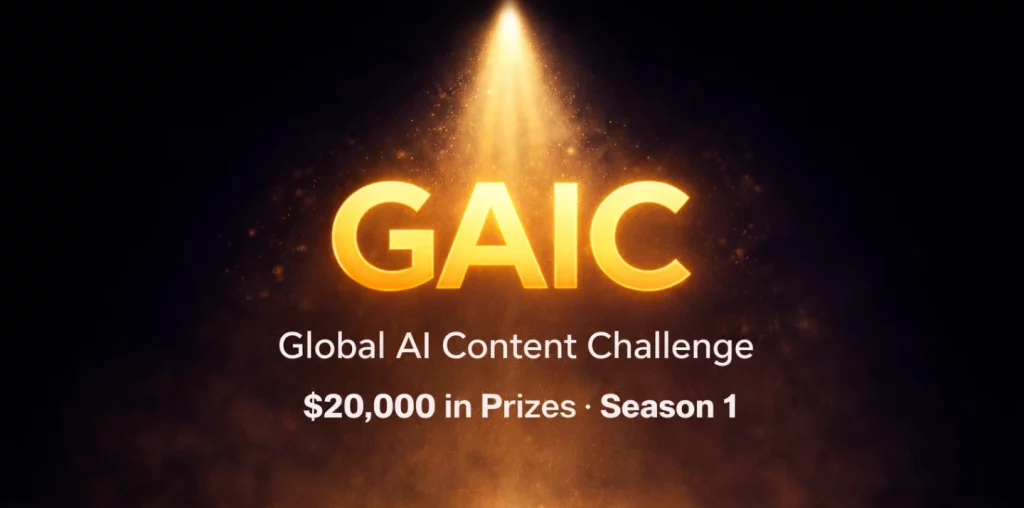
$20,000 in prizes. March 28 deadline.
And a submission pool that’s still a fraction of what it will become once this competition builds its reputation.
If you’re going to enter something this month, the math points here.
By Helena · March 2026 · 6 min read
The Film That Started It All
Last year, a filmmaker from Tunisia made an AI short film. No studio. No crew. Just him and the tools.
It won the Google Global AI Film Award. The work received $1,000,000 in recognition.
His name is Zoubeir ElJlassi. His film is called Lily.
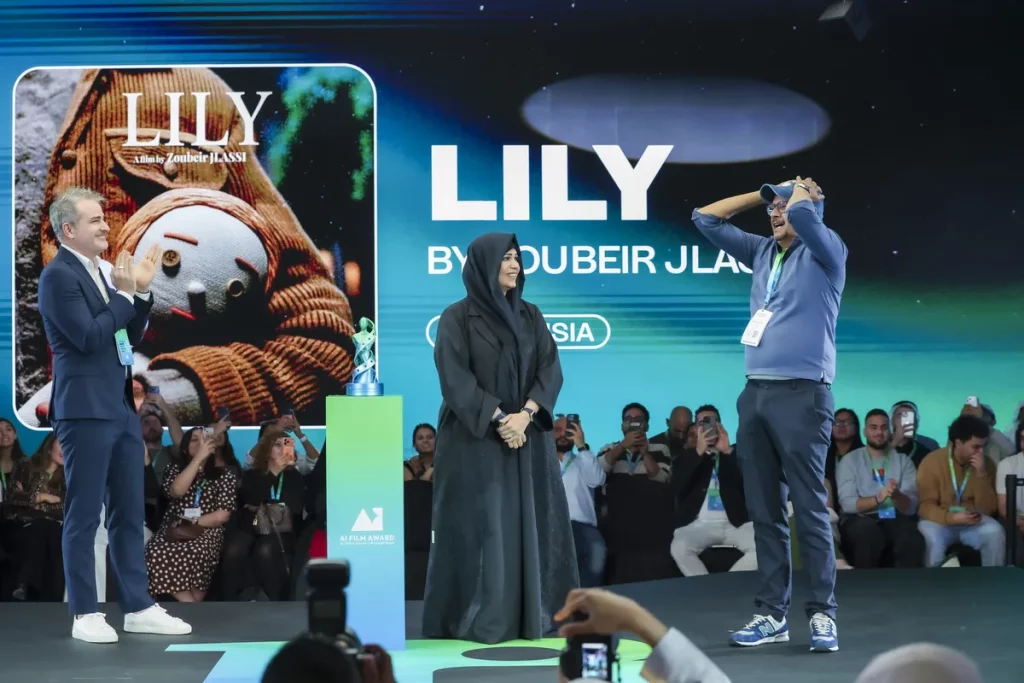
GAIC Season 1 — Ima Studio’s global AI film competition with a $20,000 prize pool — closes March 28. You have 26 days. That’s enough.
What Is GAIC?

GAIC— Global AI Content Challenge — is Ima Studio’s global AI film competition.
$20,000 in prizes. Open to anyone, anywhere.
Season 1 is centered on AI short films.
What makes it different from a traditional festival: your submission doesn’t disappear into a judging queue. The moment you submit, your film goes live in the Ima Studio community — in front of a real global audience, building real engagement before judging even begins.
The judges are looking for one thing: a story worth watching.
The Window Won’t Stay This Open
$20,000 on the table. The crowd hasn’t arrived yet.
There’s no shortage of AI film competitions in 2026.
The Google Global AI Film Award has legitimized the space. MIT AI Film Hack draws strong technical talent. Newer festivals are launching every month as the AI creative scene matures.
So why GAIC, and why now?
GAIC Season 1 is still early. The competition pool is still small. Right now, the ratio of prize money to serious submissions is more favorable than it will be once GAIC becomes a known name on the global AI film circuit.
There’s also something that most people don’t think about when they’re deciding whether to enter: the moment you submit to GAIC, your film goes live.
Ima Studio has over 2 million AI-generated works on the platform. Your film won’t be going into a vacuum. It will be entering a living community — and the earlier you’re in it, the longer it has to grow.
Ready to Enter? Here’s Everything You Need
Who can enter: Anyone, anywhere. Individual creators and teams are both welcome. There are no geographic restrictions and no professional experience requirements.
What to submit: An AI short film for Season 1. The work should be created using AI tools — there’s no single platform requirement, but Ima Studio’s integrated toolset is built specifically for this kind of project.
Deadline: March 28, 2026. No extensions.
How judging works: Submissions are evaluated on story, creative vision, and how thoughtfully AI tools are used in the work. Technical complexity is not a judging criterion. A simple story told with clarity and emotional honesty will score higher than a technically impressive film with nothing to say.
Where to submit: Directly through the Ima Studio platform at imastudio.com/gaic.
Need a step-by-step walkthrough? We put together a full submission guide: everything you need to submit your first entry is right here.
What the Judges Are Actually Looking For — What Lily Taught Us
Lily won for one reason: it made people feel something.
That sounds simple, but it’s not.
Most AI short film submissions — and we’ve seen a lot of them — fall into one of two traps.
The first is the demo reel trap: a series of visually impressive AI-generated shots that showcase what the tools can do, but don’t add up to anything.
The second is the concept trap: an interesting idea that never quite lands emotionally because the execution is too abstract, too clever, or too focused on the AI itself.
Lily avoided both. It had a character, a feeling, and a reason to exist beyond demonstrating that AI can make films. That’s the bar.
The judges at GAIC — like judges at every serious film competition — are asking one question when they watch your submission: did this make me feel something I didn’t expect to feel? If the answer is yes, everything else is secondary. If the answer is no, no amount of technical sophistication will save it.
What Makes an AI Short Film Actually Work
Lily is nine minutes long. It’s in French.
It’s about a lonely archivist in a rain-soaked city who hits someone with his car, drives away, and spends the rest of the film haunted by a child’s doll that gets caught on his bumper — a doll ElJlassi named after his own daughter. The archivist confesses. He finds the child in the hospital. He tries to make things right.
That’s the whole story.
Out of 3,500 submissions from 116 countries — many of them exploring AI consciousness, speculative futures, and the nature of humanity — the one that won was about guilt, a doll, and a man trying to do the right thing.
This is the part worth sitting with before you start creating.
The story has to be about something human, not something AI.
Most competition submissions make the same mistake: they let the technology set the agenda. The story becomes a vehicle for showing what AI can generate — surreal visuals, impossible physics, synthetic worlds. It looks impressive. It doesn’t stay with you.
Lily went the other direction. The AI is invisible. You watch it and feel the weight of someone carrying guilt, not the technical achievement of generating a rain-soaked city. ElJlassi didn’t use AI to show off what AI could do. He used it to tell a story he already cared about — one inspired by his own daughter’s doll, by the quiet way objects become witnesses to moments we’d rather forget.
That’s the bar. Not technical. Personal.
Small and specific beats large and universal.
The temptation, especially for a competition, is to go big. To pick a theme that sounds important — AI and humanity, the nature of consciousness, the future of civilization. These themes feel significant. They’re also almost impossible to execute in under ten minutes without feeling shallow.
The films that land are almost always about one thing. One decision. One relationship. One object that carries more weight than it should. Lily is about a doll on a bumper. The entire emotional architecture of the film rests on what that object means — to the man driving the car, to the child who lost it, to the audience watching both of them. The smaller the object, the bigger it can become.
Restraint is a directing choice, not a limitation.
ElJlassi’s background is in visual design. That training shows — not through stylistic excess, but through what he chose to leave out. Every frame in Lily is shaped to serve the emotional arc. There are no flourishes for their own sake. The gloomy aesthetic isn’t decoration; it’s the character’s interior state made visible.
In a competition full of films that wanted to prove what AI could generate, Lily was the one that felt like someone made a deliberate choice about every single frame. That restraint is what the jury noticed. It’s what audiences feel before they can name it.
One moment of genuine emotion outweighs ten impressive sequences.
Find the frame in your film where everything converges — where the audience’s chest tightens, or something shifts that they didn’t see coming. That moment is your film. Everything before it is setup. Everything after it is resolution.
Once you know what that moment is, build backwards from it. What does the audience need to feel for it to land? What do they need to know, and care about, before they get there? Strip everything that doesn’t serve that. A film with one genuine emotional moment and nothing else will be remembered. A film with ten impressive sequences and no core will be forgotten before the credits finish.
Sound is half the film — and most entries treat it like an afterthought.
This is the single biggest gap between submissions that feel professional and submissions that don’t. AI video tools have gotten extraordinarily good at visuals. The bar for image quality has risen dramatically across competition submissions. What hasn’t risen at the same rate is audio.
A film with intentional sound design — music that moves with the emotional arc, ambient sound that grounds the world, silence that is chosen — feels like a completely different class of work from one where audio was added at the end because it had to be. Viewers feel this difference before they can articulate it. Silence is a powerful choice. But it has to be a choice.
Let real people watch it before you submit.
Real audience behavior is more honest than your own instincts — and more honest than feedback from people who know you. Post your film in the Ima Studio community before the deadline. Watch what happens. Where do people keep watching? Which moment gets the most engagement? That signal is the most reliable editorial feedback you’ll get.
This step also has a practical upside: every day your film is live in the community before March 28 is a day it’s building real engagement data. That momentum carries into judging.
Where to Build Your Film
Ima Studio is an All-in-One AIcreative platform — image, video, audio, and character consistency in one place, with Seedance 2.0, Sora 2, VEO-3, and Nano Banana 2 all ready to go.
When an idea is moving, you stay in that flow.
The other thing worth knowing: when you submit to GAIC, your film goes live in the Ima Studio community — a real creative space with over 2 million AI-generated works. Your film gets seen by people who care about this kind of work, from the moment it goes up. That exposure builds before judging even begins.
If you’re new to Ima Studio, you get 200 free credits on signup, with more through daily tasks. That’s enough to start building tonight — a first scene, a character, a visual direction. You don’t need to have everything figured out before you begin.
Most people who end up submitting something started with much less than they thought they needed.
One More Thing
Season 1 closes March 28.
ElJlassi had a story, he had the tools, and he started. Lily is what came next.
Yours is waiting.
About The Author