









This guide explains what TikTok completion rate is, why viewers scroll away before the end, and the three most important factors that affect completion rate. At the end, I’ll also recommend a free AI completion rate checker. You can upload your video and get an analysis report that estimates your predicted completion rate. I tested it with three videos myself, and so far the accuracy looks pretty good, with the estimated results staying within about ±5% of my own test results.

What Is TikTok Completion Rate?
TikTok completion rate is the percentage of total plays that reach 100% of the video.
The basic formula is:
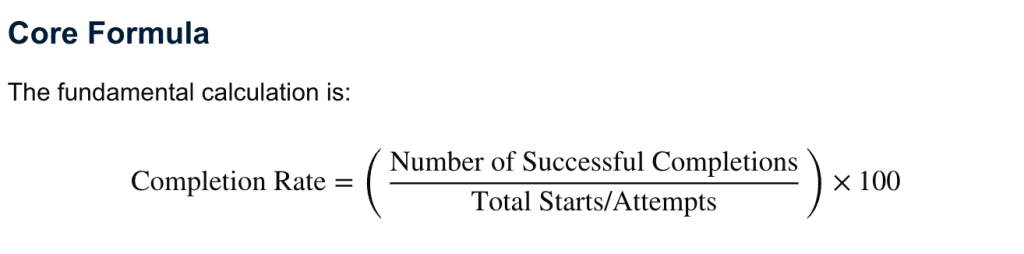
Completion rate is related to average watch time and watch depth, but they are not the same metric.
- Average watch time: how many seconds users watch on average
- Watch depth: which part of the video users usually reach
- Completion rate: how many plays actually reach the end of the video
A video may have a low completion rate but a long average watch time. It may also get a high completion rate simply because it is very short, while still failing to generate likes, comments, or shares.
So when judging video performance, you should not rely on a single number.
Why Is Your TikTok Completion Rate Low?
A low completion rate is usually not caused by one single issue. It is often the result of several small structural problems adding up inside the video.
Common reasons include:
- The opening takes too long to get to the point
- The first few seconds do not show a clear result or benefit
- The hook does not match the rest of the content
- The product or core value appears too late
- The middle section repeats the same idea without adding new information
- The video is longer than the idea actually needs
- The CTA continues for too long after the main content is already finished
- The ending does not create a reason to keep watching or rewatch
Two videos can both have a low completion rate for completely different reasons. One may lose viewers in the first 3 seconds. Another may slow down in the middle. A third may finish the main point early but lose viewers because the ending drags on too long.
Find Out Where Viewers May Scroll Away
When you watch your own video repeatedly, it is easy to miss the parts where the pacing feels slow or the message becomes repetitive, because you already know what the video is trying to say.
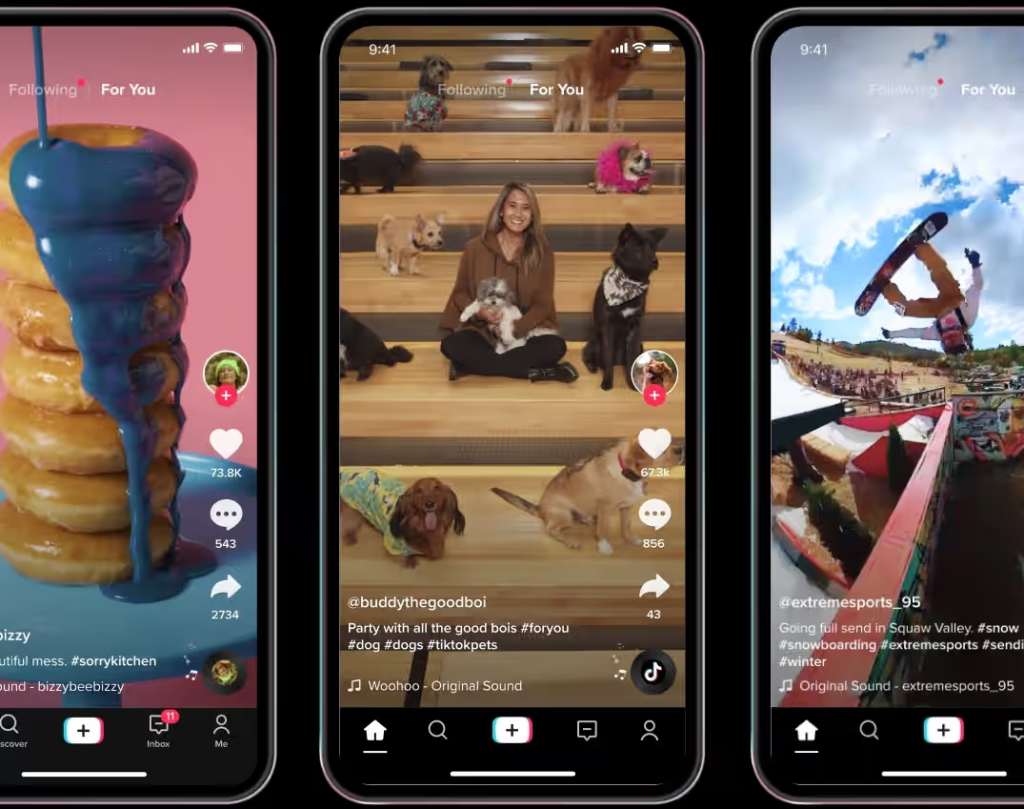
You can upload your video for a pre-publish analysis, estimate its completion potential, and identify the parts most likely to cause viewer drop-off.
The 3 Most Effective Ways to Increase TikTok Completion Rate
1. Give Viewers a Reason to Keep Watching in the First 3 Seconds
For most videos, the first major drop-off usually happens at the beginning.
If your video starts with a self-introduction, background setup, or several seconds explaining “what I’m going to talk about today,” viewers may scroll away before the core content appears.
A more effective approach is to show one of these in the first frame or first 3 seconds:
- The final result
- A clear problem
- A strong visual change
- The product effect
- A before-and-after comparison
- The benefit the viewer will get
For example, instead of opening with:
Today I’m going to introduce a method that can improve ad production efficiency.
You can show the result directly:
We created 12 different ad versions for the same product in one day.
Let viewers see something worth staying for first, then explain the process.
Ask These 3 Questions When Editing the Opening
- Does the first frame already communicate the topic?
- Can viewers understand what they will get within 3 seconds?
- If you remove the first two seconds, does the video still make sense?
If deleting the opening makes the video more direct, the original setup was probably unnecessary.
2. Move the Core Value Earlier and Remove Repetition in the Middle
Even if the opening successfully keeps viewers watching, the video can still lose momentum in the middle.
The most common problem is that the truly valuable information appears too late, while too much time is spent on background, repeated points, or similar visuals.
Viewers do not necessarily dislike longer videos. But they will leave content that stops moving forward.
To improve mid-video retention, check these points first:
- Can the core selling point appear earlier?
- Are there several seconds with no new information?
- Is the same idea repeated twice?
- Does the visual stay in the same state for too long?
- Does every shot move the content forward?
For example, in a product video, do not wait until second 8 to show the effect. Show the effect first, then explain the process and details.
For educational videos, do not hide the answer until the very end just to create suspense. You can give part of the conclusion earlier, then use the rest of the video to explain why.
A Simple Editing Rule
Every section of the video should provide at least one new thing:
- New information
- A new visual
- New proof
- A new emotion
- New progress
If a section does not add any value, consider shortening or deleting it.
3. End Quickly After the Value Has Been Delivered
Many videos have already delivered the main point, but still keep a long ending that asks viewers to follow, buy, click a link, or visit the profile.
This can cause viewers to exit just a few seconds before the end, lowering the overall completion rate.
A CTA is not more effective just because it is longer. A better ending is short, clear, and naturally connected to the content.
For example, instead of spending 4 to 5 seconds saying:
Remember to like, follow, comment, save, and click the link in my bio.
You can use one more specific action:
Save this checklist before editing your next TikTok.
Or:
Which version would you test first?
These CTAs do not just ask viewers to take action. They also give viewers a reason to interact.
For shorter videos, you can also try connecting the last frame naturally back to the first frame to create a smooth loop. A loop cannot replace content quality, but it can reduce the sense of a hard ending and increase the chance of rewatching.
Questions to Ask When Checking the Ending
- Does the video continue for several seconds after the core value is already delivered?
- Can the CTA be shortened into one sentence?
- Can the CTA be built into the content instead of being left as a separate ending?
- Can the final shot connect naturally back to the opening?
Before-and-After Example
Here is a structural comparison of the same product video before and after editing. The estimated completion rate is a tool prediction and is used only to show the analysis method. It does not represent a guaranteed improvement.
| Element | Original Version | Optimized Version |
|---|---|---|
| Product appearance | Product appears at second 6 | Result appears in the first frame |
| Opening | 2-second self-introduction | Starts directly with the user problem |
| Core value | Main benefit appears after setup | Main benefit appears in the first 3 seconds |
| Middle section | Repeated feature explanation | Uses comparison visuals to move the message forward |
| Ending CTA | Lasts 4 seconds | Shortened to one sentence |
| Estimated completion rate | 38% | 57% |
The point of this example is not that one tactic will always create a fixed improvement. It shows that completion rate usually improves through several structural adjustments working together.
The most important things to fix first are still:
- Get to the point faster
- Deliver value earlier
- End the video at the right time
Pre-Publish Checklist
Before publishing your video, check these questions:
- Does the first frame already show the result, problem, or benefit?
- Do the first 3 seconds give viewers a clear reason to keep watching?
- Does the product or core value appear early enough?
- Does the middle section contain repeated information or dead pauses?
- Is there any shot you can delete without hurting understanding?
- Does the CTA continue too long after the core content is finished?
- Is the video longer than the idea actually needs?
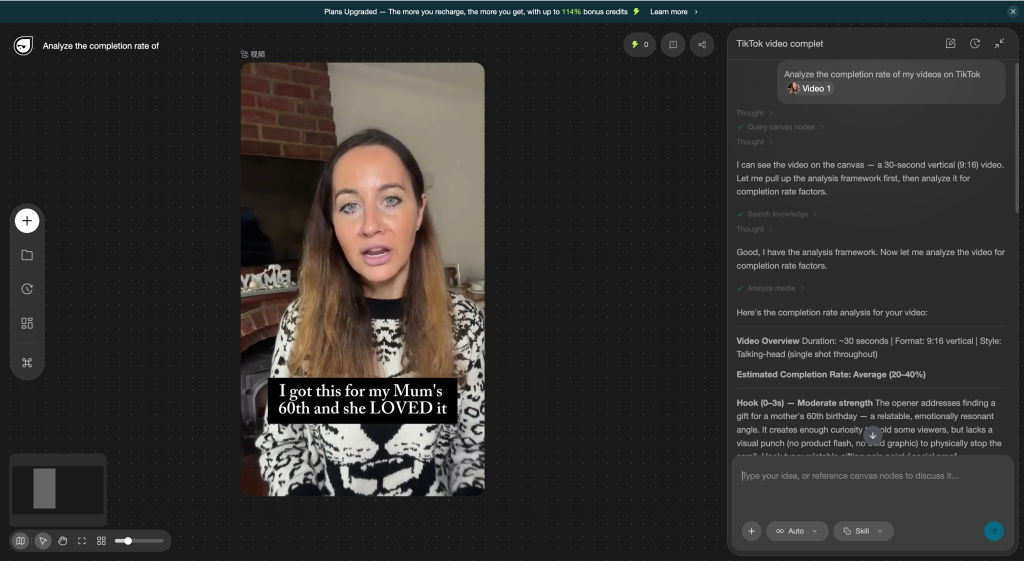
If it is hard to judge by yourself, you can upload your video and use the tool to analyze it. It can show the estimated completion rate, hook strength, pacing issues, and likely drop-off points, so you can decide which section to delete, which message to move earlier, or which part to shorten.
Conclusion
Increasing TikTok completion rate does not mean changing dozens of complicated factors at once.
The three areas worth fixing first are:
- Whether the opening is fast enough
- Whether the middle section keeps delivering new value
- Whether the video ends at the right time
Fixing these three problems is usually more effective than simply adding more captions, speeding up transitions, or forcing the video to be shorter.
If you do not know where your video is losing viewers, analyze the potential drop-off points first, then adjust the hook, pacing, length, and CTA based on the results. This turns completion rate optimization from guesswork into a clearer editing workflow.
FAQ
What is a good TikTok completion rate?
There is no single benchmark that applies to every video. Completion rate depends on video length, content type, audience, and publishing context. Short videos naturally tend to get higher completion rates, while longer videos should be evaluated together with average watch time, watch depth, and engagement.
How is TikTok completion rate calculated?
The basic formula is:
Completed plays ÷ total plays × 100%
Why is my TikTok completion rate low?
Common reasons include a slow opening, late core value, repetitive middle section, a video that is longer than the idea needs, and a CTA that drags on too long.
Does a high completion rate guarantee a viral TikTok video?
No. A high completion rate means the video can hold some attention, but performance also depends on audience match, watch time, likes, comments, shares, and the overall value of the content.
Does video length affect completion rate?
Usually, yes. The longer a video is, the harder it is for viewers to reach the end. But this does not mean every video should be extremely short. The key is matching video length with information density.
Can I predict TikTok completion rate before posting?
You can estimate completion potential based on the hook, pacing, information density, visual changes, and ending structure. But a predicted value cannot replace real post data. It is more useful for finding structural issues and comparing different edits before publishing.
How accurate is the estimated completion rate?
Estimated completion rate is a pre-publish diagnostic reference, not official TikTok data, and it cannot guarantee actual results. Its main value is helping you identify issues in the opening, middle section, and ending that may affect retention.
About The Author