









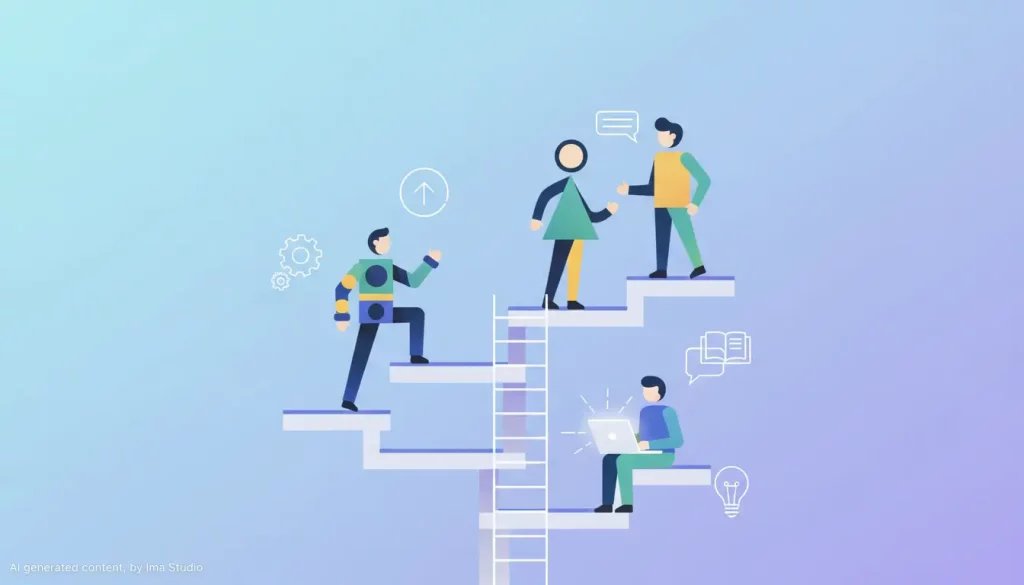
Make your path clearer, and your future more intentional
We created this guide because we don’t want “career development” to only appear in your performance review once or twice a year. We want you to see:
- Where you can go
- What it takes to get there
- How the company will support you along the way
This is a practical overview of how you can grow here—whether you want to deepen your craft, expand across domains, or move into people leadership.
1. Why do we need this guide?
We want everyone to be able to clearly answer three questions:
- What direction am I growing toward?
- Which skills and behaviors do I need to level up?
- What will the company do to support my growth?
This guide is about making those answers explicit and repeatable, not vague or based on luck.
2. Multiple paths, not a single ladder
We don’t believe everyone has to climb the same “management ladder”. You can grow in several directions:
- Deep specialist
e.g. security engineer, senior designer, infra architect - Cross-functional generalist
e.g. product + data, design + front-end - People leader
if you enjoy mentoring, aligning teams, and building systems
Instead of a rigid “management vs. expert” split, we encourage you to:
- Explore different professional domains horizontally
- Switch tracks when it fits your strengths and interests
- Build a multi-dimensional career, not just a longer title
💡 Yes, you can move between roles like designer and product manager —
as long as you have the skills to do each role well.
3. Your growth ladder: Professional levels (P1–P5)
Internally, we use a professional ladder (P1–P5) to describe growth.
Details differ by function, but the logic is consistent:
- P1–P2 – Developing individual contributor
- Delivers tasks with guidance
- Builds solid fundamentals in their craft
- P3 – Core individual contributor
- Owns features or projects end-to-end
- Proactively identifies problems and proposes solutions
- P4 – Senior / expert
- Leads complex projects and designs systems
- Mentors others and influences roadmap or strategy
- P5 – Principal / domain leader
- Shapes direction for an entire domain or function
- Creates frameworks and standards others follow
Each function has its own capability model and behavior examples, so you can see what “the next level” actually looks like in your role.
4. How do promotions work?
We want promotion to be simple, transparent, and in your control, not a black box.
Step 1 – Regular growth check-ins
About every six months, you and your leader have a dedicated conversation around:
- Your goals for the next 6–12 months
- The level you’re aiming for (e.g. P2 → P3)
- What evidence you’d need to demonstrate to get there
Step 2 – Self-driven application
When you feel ready, you can raise your hand:
- Prepare your results and case studies
(projects, impact, improvements, mentoring, etc.) - Talk with your leader and HR about your promotion request
- We’ll guide you through the process and expectations
Promotion is not a once-a-year lottery.
If you’re ready, we want a path for you to move forward.
Step 3 – Holistic evaluation
We look at:
- Capabilities – skills, behaviors, ownership level
- Contribution – real impact, not just effort or hours
- Potential – readiness for a bigger scope or higher complexity
It’s an evaluation, not an exam.
Our principle: documented criteria, clear feedback, and support from both HR and your leader.
5. Growth incentives: not just a new title
Each professional level (P1–P5) is linked to three internal salary bands:
- L1 – Meets expectations at this level
- L2 – Strong, consistent performance and growing impact
- L3 – Role model at this level, sets the standard for others
As you grow within the same level, your compensation moves from L1 → L2 → L3.
When you move up a level (e.g. P3 → P4), your salary is adjusted into the new band automatically—no extra negotiation needed.
Example:
As a P3, the stronger your capability and impact,
the more room you have to grow inside the P3 band (from L1 to L3).
Beyond salary: other growth-driven rewards
We also want you to feel progress and opportunity, not just a pay change:
- External learning & development
- Budget for courses, certifications, and industry conferences
- Cross-functional project opportunities
- Join cross-team initiatives and talent programs
- More autonomy and choice
- Greater say in what you work on and how you work
- Possible access to flexible or remote project setups where applicable
We know you care about growth and meaning, not only money.
So we design promotions to bring more responsibility, learning, and freedom—as well as fair compensation.
6. Common questions
Q: What happens if my promotion doesn’t go through?
You’ll receive specific feedback, not just “not this time”:
- What you’re already doing well
- Where the gaps are compared to the next level
- A concrete 3-month improvement plan with your leader
The goal is to give you a clear roadmap, not a closed door.
Q: I want to move into management, but I’ve never managed people.
We don’t expect new managers to “figure it out alone”.
You can first join a “shadow leader” program:
- Co-lead projects with an existing manager
- Try 1:1s, planning, and decision-making with guidance
- Get feedback on whether management is a good fit for you
If it’s a match, we’ll gradually increase your scope.
If it’s not, you can stay on or return to the expert path without stigma.
Q: How are salary bands adjusted over time?
We review bands regularly based on:
- Market benchmarks
- Company performance
- Individual and team performance
Our principles are:
fairness, competitiveness, and transparency.
7. Final thoughts: growth is not a race
Growth is not a race where only a few people “win”.
It’s a long-term exploration of:
- What you’re good at
- What you enjoy doing
- Where you create the most value
Whether you want to become a deep expert or a people leader,
our role as a company is to provide the structure, opportunities, and support to help you get there.
Your next step:
Open your calendar, and book a coffee chat with your leader ☕
Talk about where you want to be in 6–12 months—
and let’s design that path together.
This guide is based on my real work in HR and people development at our company. ChatGPT only helped translate, restructure, and polish the English wording; all frameworks, policies, and examples come from our actual internal growth system.
About The Author